From Emoticons to Reaction Images: A Brief History of Online Tone
Online tone with emoticons, emoji, and reaction images can be hard to read. Learn what each format conveys and when plain wording is clearer.
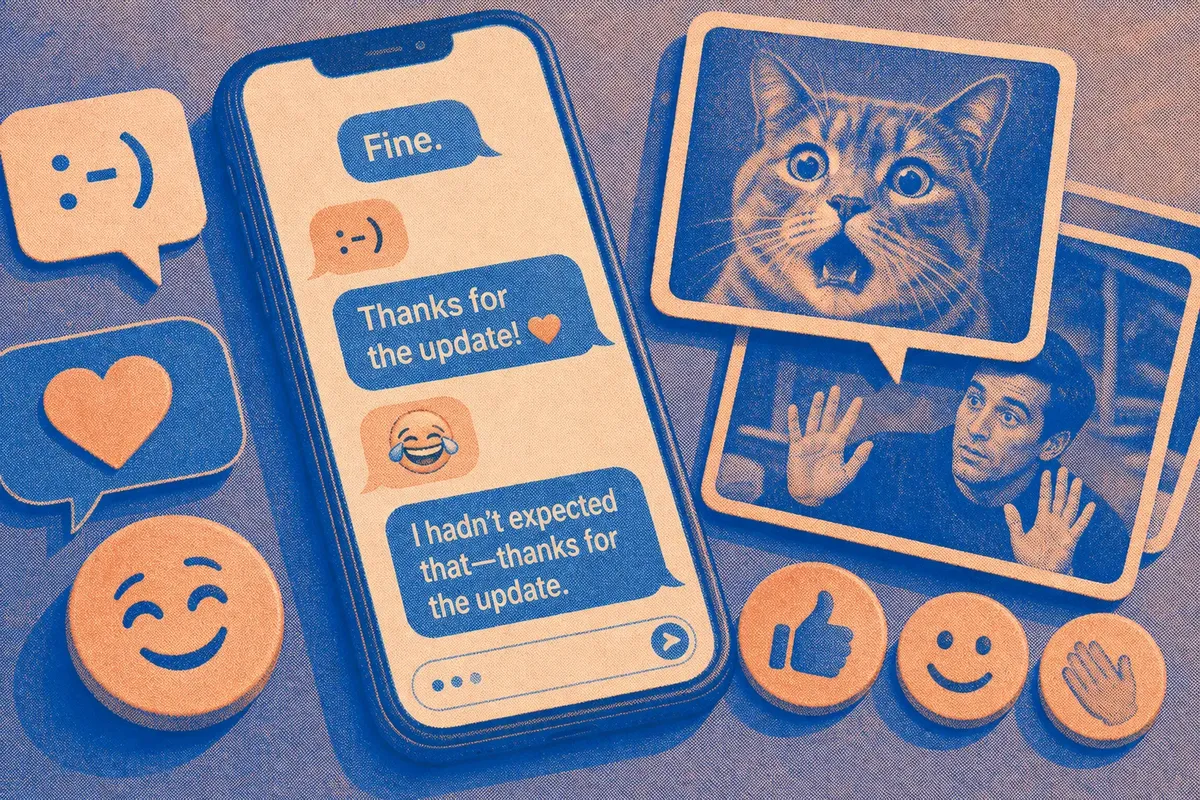
Why can the same “sure” sound warm in one message and clipped in another? Online tone often depends on small signals around the words, and readers can interpret those signals differently. Emoticons, emoji, and reaction images each add a distinct kind of cue, but none works as a universal translation key.
Online tone changes as messages gain visual cues
A spoken reply carries voice, timing, and facial expression; a typed reply usually carries words and punctuation alone. A short “Fine” could mean agreement, irritation, or simply that the sender has little time to type. Readers fill in what is missing, often using their own expectations.
Text-first services made that gap visible. People used punctuation to suggest a joke, soften a blunt sentence, or show excitement. As messaging tools added pictographs and images, the available signals grew, but interpretation remained part of the exchange.
Think of these cues like labels on a jar: they can clarify what is inside, but the label still depends on the reader understanding it. When the meaning matters, words can make the intended tone more explicit than any symbol.
Emoticons built faces from keyboard characters
An emoticon is a face or expression made from ordinary characters. The sideways smile :-) uses punctuation to suggest eyes and a mouth. A change in the mouth or an added mark can alter its suggested mood.
Because emoticons use keyboard characters, they could travel through email, chat rooms, and message boards without special image support. A small face could indicate that a line was meant playfully rather than as a serious criticism. Readers still had to recognize the convention, and the limited character set could not express every shade of feeling.
An emoticon is not a reliable substitute for context. If “:-)” after a pointed remark could look sarcastic, replace it with a direct explanation or rewrite the remark so its intent is clearer.
Emoji made tone cues into pictographs
Emoji are pictographs rather than faces assembled from punctuation. A heart, a smile, or a raised hand can add warmth, register a reaction, or stand in for an object or action. Their compact form makes them easy to add, but a compact symbol can carry several possible readings.
Different devices and apps may render the same emoji in different ways. People also learn local conventions, so a sender’s straightforward smile might seem formal or ironic to its recipient. A laughing face after a complaint, for instance, may look dismissive if the recipient is still upset.
Use the surrounding words to guide interpretation. A heart after “Thanks for helping” reinforces a warm message; the same heart after a work instruction may feel more personal than the sender intended. If that distinction matters, write the tone plainly instead of asking the symbol to carry it alone.
Reaction images rely on recognizable visual references
A reaction image or GIF turns a response into a still image or short moving clip. It can convey disbelief, delight, or exasperation, and may also express a stance toward what someone just said. Unlike a small emoji, it can draw meaning from a recognizable scene, expression, or recurring reference.
That reference is useful only when the recipient recognizes it and reads it in a similar way. A playful image for one person may look mocking or simply confusing to another. If the image does not add a clear meaning, a sentence is easier to interpret.
Say you receive a coworker’s message about a schedule change and want to express mild surprise without implying blame. You type, “I hadn’t expected that—thanks for the update,” and leave out a dramatic reaction GIF. The observable result is a reply that names your surprise and appreciation; if the coworker still asks whether you are upset, you can clarify directly rather than relying on the missing image.
Why do online tone cues still misfire?
Why can an emoticon or emoji seem sarcastic?
A familiar symbol can acquire an ironic use, and a reader may apply that meaning to a message. Look at the words around it; if the intent remains unclear, ask or clarify rather than treating the symbol as proof of a particular mood.
Why might an emoji appear differently on another device?
Apps and operating systems can draw the same pictograph differently. If the exact expression matters, describe it in words or choose a simpler message that does not depend on its appearance.
When is a reaction image likely to confuse?
It can be hard to read when the subject is sensitive, the reference is unfamiliar, or the recipient might take it as ridicule. A direct sentence gives the recipient less visual context to decode.
How can a message sound warmer without symbols?
Name the response you mean, as in “I’m glad you told me” or “I’m joking, not criticizing.” Those words make your intent more explicit than a row of faces.
Choose a tone cue by checking what the message needs
Before sending a message, inspect what a cue adds and what it could obscure. Each check leads to a concrete choice:
- Relationship: If the recipient has used the same shorthand with you, a matching cue may be clear; if not, write the intended tone in words instead.
- Subject: If the message concerns bad news or a serious concern, remove humor and reaction images; if it is a light exchange, use a cue only when it supports the words.
- Clutter: If a sentence combines emphatic punctuation, emoji, and an image, keep the one cue that best fits your meaning; if the sentence has no competing cues, leave it as written.
- Possible sarcasm: If a joke could read as criticism, label the teasing or rewrite the sentence plainly; if its playful intent is already explicit in the words, send it without adding another signal.
- Reference: If the recipient may not recognize a GIF or reaction image, replace it with a short description; if the reference is familiar and relevant, use it only if it adds meaning.
- Misreading: If someone says your message sounded different from what you intended, explain your intent and acknowledge their reading; if they understood it, continue without adding needless clarification.
Online tone with emoticons, emoji, and reaction images comes from different kinds of signals: keyboard-built faces, pictographs, and visual references. Each can add useful context, but the words around it do much of the work. When a message needs to be understood beyond a familiar shorthand, plain language remains the clearest companion.
Keep following the thread

Why the Group Chat Became a Place, Not Just a Thread
Group chat as a shared social space: understand how familiar rituals and low-pressure participation help friends…

Short Video or Long Post: What Each Format Makes Easy to Share
Short video or long post? Learn how to keep visible details, context, and uncertainty clear when…