How Feedback Loops Shape a Sudden Shift
Feedback loops help explain why change accelerates, stalls or settles, giving you a clearer way to trace causes and choose signs to watch.
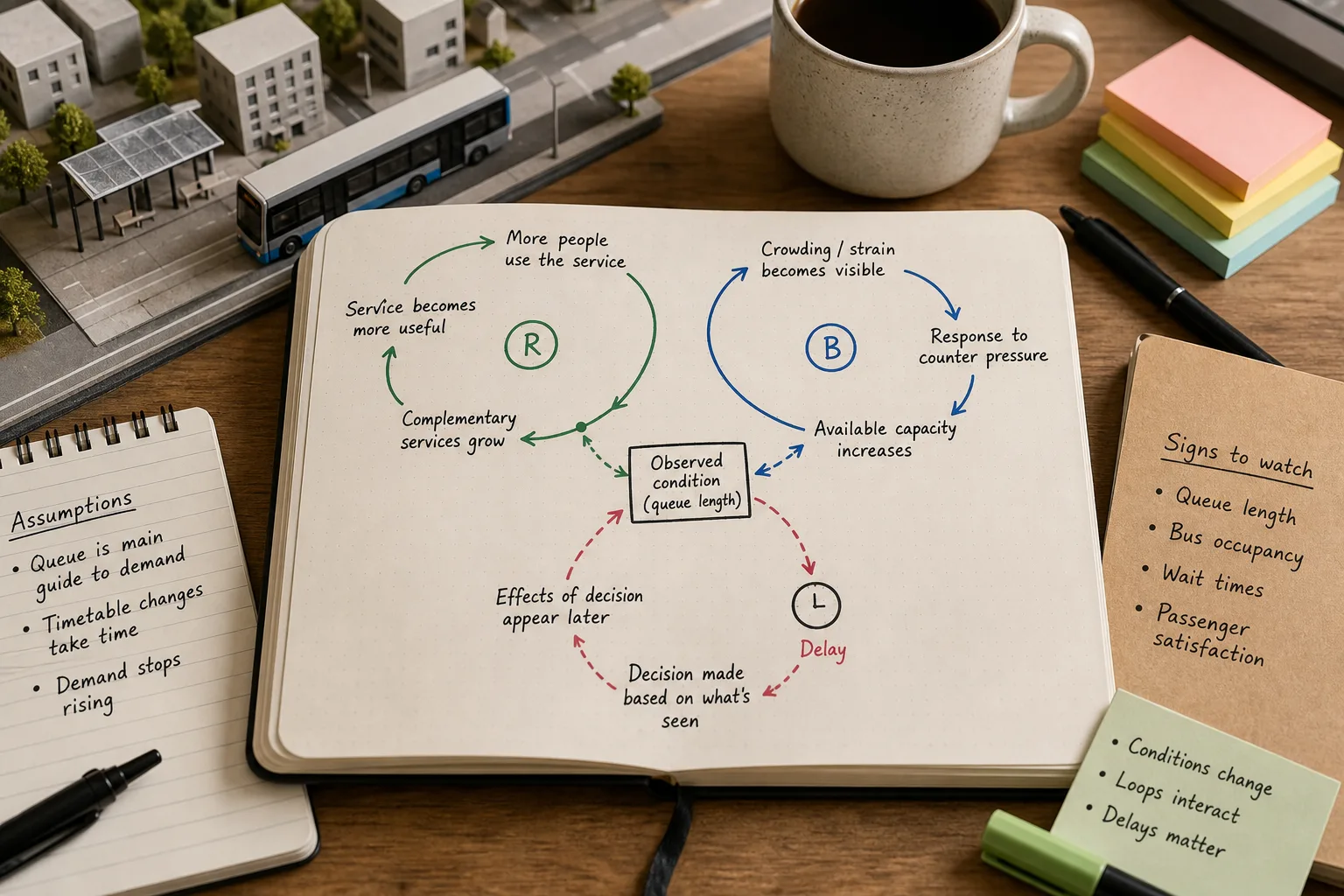
A queue can shorten, then grow again when a service change shifts demand. Feedback loops help explain how such sudden shifts develop: one change alters the conditions that produce the next. The map is useful not as a prediction, but as a way to see which assumptions could make a trend accelerate, stall or settle into a different pattern.
In futures thinking, a single pressure rarely acts alone. Reinforcing and balancing loops can interact, and their effects may appear at different times. To use a loop well, trace what changes, what responds and what would make you reconsider the explanation.
Reinforcing feedback strengthens a change
A reinforcing loop occurs when a change produces effects that strengthen movement in the same direction. “Reinforcing” describes the structure, not whether the outcome is desirable.
A service may become more useful as more people adopt it. Wider use could encourage complementary services, which might make the original service more useful and attract further users. Each link depends on conditions: complementary services must appear, and people must value them.
Systems diagrams often mark reinforcing loops with an R. The label says nothing about speed or benefit. Decline can reinforce itself too: lower use may weaken a local service, and reduced availability may give remaining customers fewer reasons to stay.
Trace consequences back to the condition that began the chain. If they strengthen movement in the same direction, the loop is reinforcing. Delays or other forces may still keep its effects from showing up straight away.
Balancing feedback counters a change
A balancing loop responds in a way that pushes against a change. It may keep a system near a preferred condition or slow a shift without reversing it.
Rising demand for a scarce material could prompt buyers to seek substitutes. If they find those alternatives acceptable, demand for the original material might ease. The response would counter the initial pressure, but its strength depends on the substitutes’ availability and suitability.
Balancing loops are often marked with a B. They can be deliberate, as with a policy intended to limit extraction, or indirect, as when people change their behaviour because a resource is harder to obtain. Several loops may operate at once and respond at different speeds.
A quick response might soften a shift early; a slow one could arrive after the system has already changed. A balancing loop need not restore the previous pattern, especially if reinforcing forces remain active.
Delays can carry a system past its target
People often act on conditions they can see, while the effects of their decisions take time to appear. This can produce overshoot: action continues after the original pressure has begun to ease because decision-makers have not yet seen the effects of earlier action.
Say a town’s growing bus queue prompts its council to add services. For this invented situation, assume arranging the timetable takes time, the queue is the council’s main guide to demand, and demand stops rising. If the council adds services again before earlier changes show up in the queue, the eventual observable result could be buses with more spare room than expected. The council might then consider adjusting the timetable. If demand were still growing, that spare capacity might not appear.
The point is not that adding service was a mistake. Under different conditions, delay could make a response too slow. Present conditions may reflect earlier decisions, while current decisions shape conditions that are not yet visible.
When tracing a loop, mark where feedback is delayed. Ask what people will see, how long the response might take and whether decisions are being made before earlier actions have had time to show their effects.
A plateau can conceal competing forces
A stalled trend does not always mean its underlying force has vanished. A balancing response may be absorbing pressure, leaving a temporary plateau or a continuing tension between loops.
Wider access to a talent pool could reinforce remote work, while coordination concerns could lead some teams to use shared offices. If both forces persist, a mixed working pattern is one possible outcome. That pattern alone would not show that the system will return to an earlier arrangement or accelerate in either direction.
In foresight, a pause can look like an endpoint when it is only the visible point of tension between forces. Ask what is holding the system in place and whether that constraint could change, weaken or be replaced.
It is not worth treating every plateau as hidden acceleration waiting to happen. A system may have reached a durable balance. Identify the forces maintaining it rather than assuming either reversal or renewed growth.
Interacting loops can establish a different pattern
When reinforcing and balancing loops interact, the outcome may be neither runaway growth nor a return to the starting point. The system could settle into a different pattern, shaped by new expectations and constraints.
Imagine a city introducing shared bicycles. More stations could make the service convenient, encouraging use and supporting further expansion. Limited kerb space, maintenance demands and local opposition could slow that expansion. One possible result is a network that becomes more established in some districts than in others; that depends on how those constraints and responses develop.
A new pattern can also change the conditions shaping later choices. Residents may adapt their journeys, shops may respond to foot traffic, and transport planners may consider bicycles alongside other services. The loops then operate within a changed system, not the one that existed at the outset.
Map what each loop might strengthen or limit. Then ask which conditions would need to persist for the pattern to hold. This gives a more useful account of change than drawing a single line pointing up or down.
Build a feedback loop map from observable conditions
A simple causal loop sketch can clarify a possible mechanism without claiming to predict the future. Use concrete conditions, write down your assumptions and let each decision follow from what the map shows.
- Check the starting condition. Write an observable condition, such as service use, water demand or trust in an institution. If its direction is unclear, gather more observations before drawing the loop; if its direction is clear, record the change you can describe and proceed.
- Check the next consequence. Ask what changes because the starting condition moved. If you cannot name a plausible, observable consequence, leave that link out; if you can, add it and write the assumption connecting the two.
- Check the return path. Trace consequences back to the starting condition. If the return path strengthens movement in the same direction, mark a reinforcing loop; if it counters that movement, mark a balancing loop.
- Check for delay. Ask whether the consequence appears straight away or only after scheduling, construction or a change in behaviour. If it is delayed, mark where decisions could precede visible effects; if no delay is plausible, leave one off the map.
- Check for a constraint. Consider whether capacity, rules or resources could limit the chain. If you can name a specific constraint, add it as a possible balancing influence; if you cannot, keep the loop open to revision rather than inventing one.
- Check for a competing loop. Ask whether another response could reinforce or counter the first loop. If you can describe one, map it separately and compare the conditions each depends on; if none is apparent, record that absence and revisit it if the conditions change.
- Check the least certain link. Choose an observable sign tied to the link you trust least. If the sign appears, reconsider whether the link remains plausible; if it does not, revise the map or choose another sign rather than treating the original account as settled.
For a worked invented case, suppose a library sees a longer queue for its study rooms. Assume the queue reflects demand, room bookings are visible to staff, and opening another room would require a staffing change. First, the library records the queue and booking pattern as its starting conditions. Next, it links longer queues to earlier bookings and asks whether those bookings encourage people to return; if they do, repeat use could reinforce demand. Then it maps a balancing response: staff may open another room if cover is available, easing the queue. Because arranging cover takes time, the map marks a delay between the decision and the extra room becoming available. The resulting answer is conditional: if repeat bookings persist and cover can be arranged, demand may be met by added capacity; if cover is unavailable, the queue may remain, so staff should not interpret a short pause as proof that demand has eased. The observable signs are repeat bookings, a confirmed staffing change and the queue after the room opens.
Keep the map modest. A crowded diagram can hide uncertainty behind arrows. Write assumptions beside the links they support, then ask what observation would make each assumption less plausible.
Which feedback loop questions help explain a shift?
How can I tell whether a feedback loop is reinforcing?
Trace the consequences back to the condition that began the chain. If they intensify movement in the same direction, the loop is reinforcing; if they counter it, the loop is balancing.
Can a balancing loop contribute to a sudden shift?
It could contribute if a constraint changes or a delayed response arrives, depending on the conditions in the system. The visible change might be abrupt even if the forces behind it have been developing over time.
Why might a shift stop accelerating?
Growth could meet a limit, a balancing loop could strengthen, or the conditions sustaining a reinforcing loop could weaken. A pause alone does not tell you which explanation applies.
What should I watch after mapping a loop?
Choose an observable sign linked to the least certain part of the loop, such as whether a constraint is easing or a response is arriving. If it does not appear as expected, revise the explanation rather than forcing the observation to fit it.
Feedback loops shape a sudden shift only through conditions that can be named and questioned. Use a feedback loop map to connect an explanation to observable signs, then change the map when those signs or the underlying conditions change. A useful diagram makes clear not only what might happen next, but what would persuade you that its account is wrong.