Two Plausible Futures, One Present-Day Choice
Compare two plausible futures to see how different conditions alter one decision, reveal who bears the trade-offs and show what needs attention before committing.
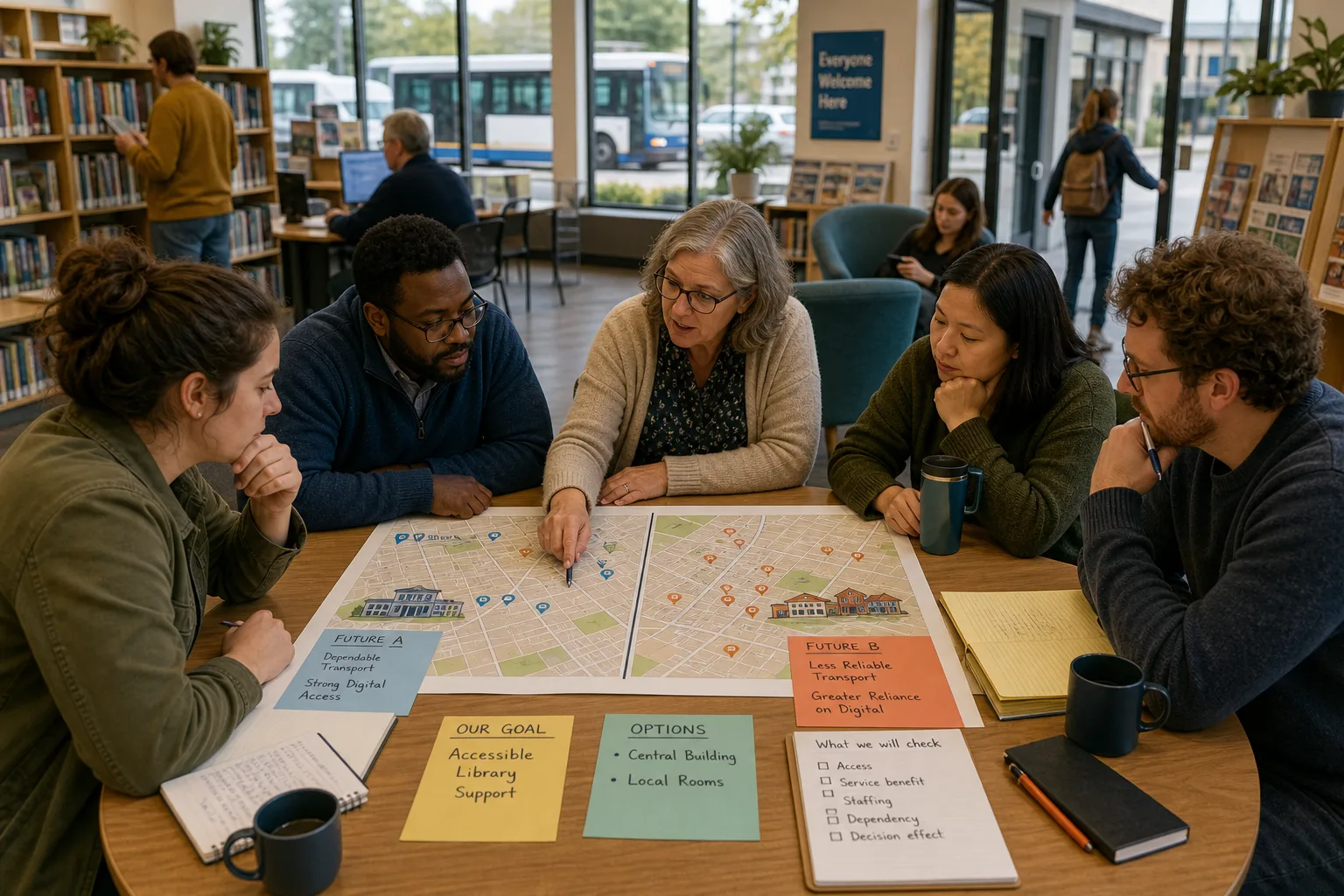
Two plausible futures can change how a public library weighs a central building against a network of local rooms. In one, travel to the centre is dependable; in the other, some residents struggle to reach it while digital services become more useful. That difference matters because it changes who can use the service, not merely the story told about its future.
Scenario comparison is not a forecast or a contest to find one universally best option. Its purpose is to expose the conditions on which a present choice depends, and to make the consequences visible before the decision is fixed.
Start with a choice that has a real alternative
“How will libraries change?” is too broad to guide a decision. “Should the service commit to one central building or retain local rooms?” sets out an action and a credible alternative.
Keep the goal separate from the delivery model. The goal might be accessible library support; a central building and local rooms are different ways to provide it. Record who can make the decision, who will be affected and which constraints cannot be changed.
It is not worth polishing scenario names or writing elaborate future histories at this point. If the stories do not alter how the choice looks, they are decoration rather than useful comparison.
Make the futures differ in a way that affects the choice
Choose a condition that changes the options’ consequences. For a library service, one contrast could be reliable transport to the centre versus less reliable travel for some residents. A second, related condition might be whether digital channels can meet more of those residents’ needs.
Keep each future coherent, but do not add details simply to make it vivid. Ask what the changed condition means for access, staffing, specialist services and the people who rely on them. If the options look exactly the same under both futures, the contrast is not doing useful work.
Use the same points of comparison for each option. That keeps attention on what changed between the futures, rather than on differences in how the options were described.
Trace who benefits and where each option strains
A central building could bring shared equipment and coordination together. With dependable transport, it may be accessible to many residents. If travel becomes harder and digital access does not meet someone’s needs, that same arrangement could leave them with a greater barrier.
Local rooms could keep some services close to home in either future. They may, however, make it harder to organise staff and specialist provision. Those consequences are not interchangeable: the comparison should show who gains convenience and who carries extra difficulty.
A working note can make the comparison concrete. For each item, write down what the scenario implies and follow the decision path shown here:
- Choice: Check that the central building and local rooms are both feasible options; if one is not, compare the remaining option with a realistic alternative such as a smaller central site or shared venues.
- Changed condition: Check whether transport reliability or digital access differs between the futures; if neither changes access to the options, replace the contrast with a condition that does.
- Access: Check which residents can reach each service in each future; if a group would lose practical access, identify an alternative route or service point and compare its implications.
- Service benefit: Check whether shared equipment or nearby provision meets a stated need; if the benefit relies on an unconfirmed assumption, seek clarification before treating it as decisive.
- Staffing: Check whether the proposed team can cover central and local provision; if local coverage would stretch capacity, consider fewer rooms, different opening arrangements or another delivery model.
- Dependency: Check whether an option relies on transport, digital access, a supplier or a particular skill; if that dependency is fragile, identify a workable substitute or avoid making the commitment depend on it.
- Decision effect: Check whether the changed condition alters the preferred option, its design or neither; if it changes nothing, test whether the scenarios differ on a condition that matters to the choice.
Do not force the options into a neat score. A comparison can remain uneven: one arrangement may serve more people in one future while creating a serious access problem for a particular group.
Notice weaknesses that persist across both futures
Some problems do not depend on which future unfolds. A library network may need more staff than the service can provide, whether transport is reliable or not. That shared weakness deserves attention in its own right.
Look for dependencies that appear in both accounts: a single site, a specialist contractor, a narrow skill base or an assumed funding source. If the weakness could undermine either option, address it directly instead of multiplying scenarios.
What questions help compare two plausible futures?
Do two futures predict what will happen?
No. They describe contrasting conditions for examining a decision, not a complete forecast. State the assumptions behind each consequence so readers can see what the comparison does and does not establish.
What if one future seems more likely?
Record why decision-makers favour it, then still consider the other plausible condition. A less-favoured future can expose an access problem or dependency that a choice based on the preferred outlook would miss.
What if both futures favour the same option?
Check that the conditions differ in a way that should affect the choice, and that affected groups and shared dependencies are included. If the option remains preferable, state the limits of that finding rather than treating it as a universal answer.
When should the comparison be revisited?
Revisit it if a specific change could alter the decision, such as a revised transport plan or a new service requirement. Name the person or group responsible for noticing that change and the authority responsible for reviewing the choice.
Work through the consequences before committing
Say a regional library service is deciding between one central building and keeping local rooms. In this invented situation, the decision-makers consider two conditions: dependable travel to the centre, and less reliable travel for some residents alongside greater use of digital services. These are illustrative assumptions, not claims about a real service.
They first define the goal as accessible library support. Then they compare both options under both conditions. The central building offers shared equipment and coordination, but becomes harder to reach in the second future. Local rooms keep some services nearby, but may stretch staff and cannot necessarily provide every specialist service.
The comparison changes the decision discussion: a firm commitment to the central building depends on whether travel and digital access will be adequate, while a local network depends on whether staffing can cover it. The decision-makers therefore have a specific trade-off to resolve—access for residents who may struggle to travel, against the capacity needed to operate nearby rooms. The observable result is a choice framed around those dependencies, rather than an unexamined preference for one kind of building.
Keep the record tied to the decision
Write down the options, the condition that changes between futures, the people affected and the assumptions behind each consequence. If the comparison exposes a concern, examine that concern instead of expanding the scenarios for their own sake.
For this kind of scenario comparison, a useful record also names the change that would reopen the choice and who has authority to do so. That gives the work a practical endpoint: not certainty about the future, but a clearer account of what could make today’s decision fit less well.